|
Circles and rotation as scaffolds
for STEM education (DRAFT)
|
|
Learning
intention: Students
investigate the properties of circles and rotation to extend
their STEM knowledge and skills.
|

What is STEM?
STEM stands for Science, Technology, Engineering and Mathematics. Some people think that STEM is an 'umbrella' term where any one of these disciplines is STEM. Most STEM educators such as Timms et al., (2018) suggest an integrated approach where two, three or four of the disciplines are involved.
This unit on circles and rotation uses a lot of mathematics and science, mainly physics. Physics is the natural science that studies the fundamental principles of the universe, exploring matter, energy, motion, space, time, and forces. This video (3:58) by Frank Gregorio provides a really good introduction to physics because it makes connections to everything around us.
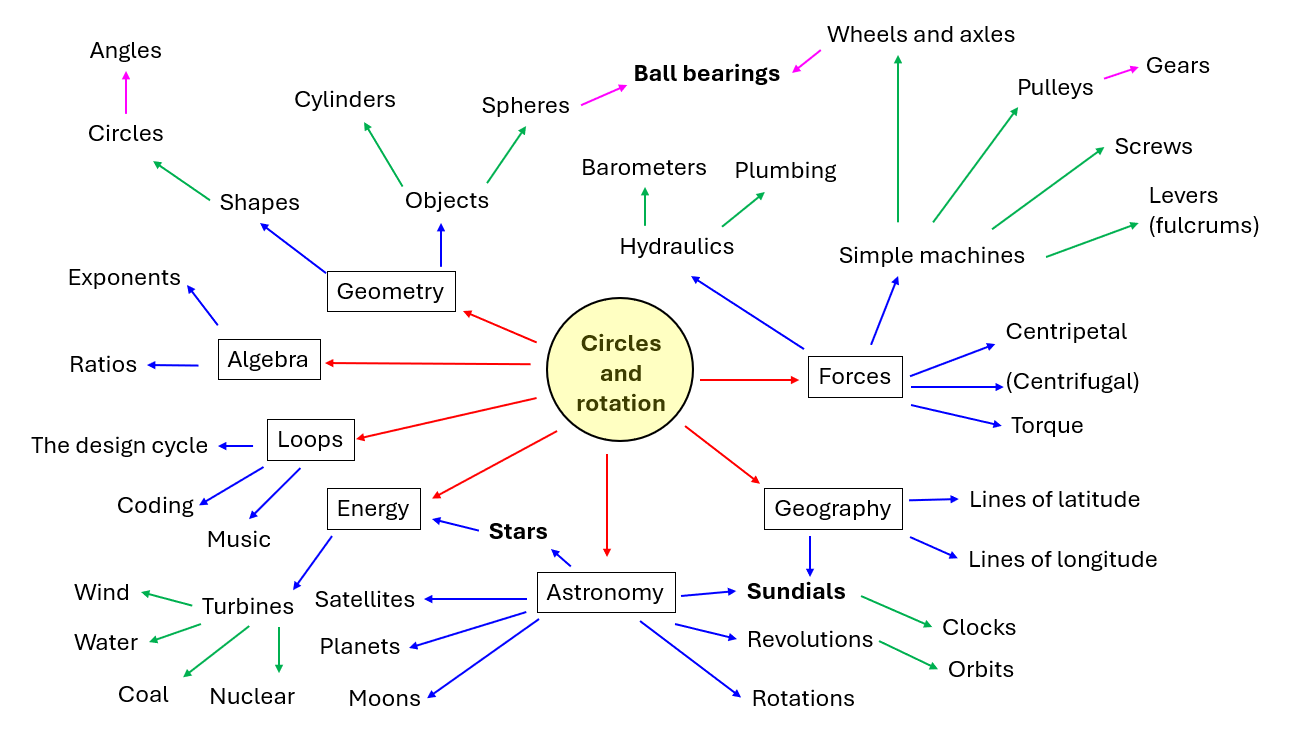
A concept map for circles
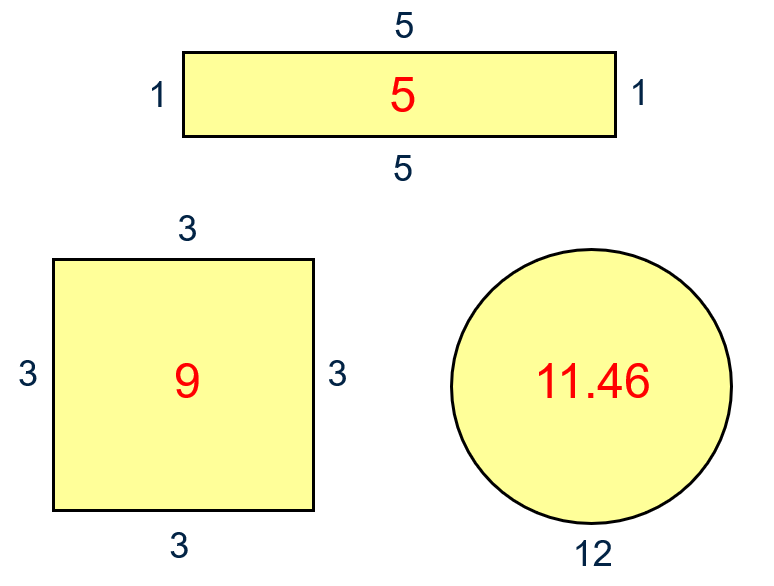
Perimeter and area
Perimeter is the distance around a shape. Area is the
space inside a shape.

 |
|
Shapes and their superpowers
Different shapes are used when building things because of their properties.
 |
The following three shapes have their own 'superpower'. What makes them special in terms of their use in construction? |

Angles
The following video (6:25) is an introduction to angles.
Revision of fair tests
The following revision of fair tests is in preparation for the projectile investigation.
Independent variables
In science experiments, the independent variable
is the thing that you change.
Dependent variables
In science experiments, the dependent variable is
the thing that you measure.
Control variables
In science experiments, the control variables are the things that remain the same.

(Image source http://downunderteacher.blogspot.com/2012/01/freebie-science-variables-and-job-roles.html)
 |
Projectile investigation |
The following investigation involves air rockets but it would be more precise to call these rockets projectiles. This is because there is no fuel to keep the rocket moving after the initial launch force provided by your foot pushing down on the air as shown in the short video (0:08) below.
The image below shows that 45 degrees
should give you the longest distance.

(Image source https://stickmanphysics.com/stickman-physics-home/two-dimensional-motion/projectile-motion/ © https://stickmanphysics.com/)
The projectile below is set to launch at 40 degrees.

Investigation steps
- This investigation is about verification to test the following hypothesis; "If the projectile is launched at an angle of 45 degrees, then it should go further than all other angles".
- Each student gets to launch three projectiles.
- A student, helper or teacher can help set the angle depending on the angles specified by the student.
- The first angle should less than 45 degrees, the second angle should be equal to 45 degrees, and the third angle should be greater than 45 degrees.
- A long tape measure is left on the ground to show the distances of each projectile. The readings are best taken by a student, helper or teacher who can read the distances quickly and accurately.
- The data for each launch is called out by the reader and then entered by a different student so the launching student can focus on placing each projectile on the tube and launching it.
- Other students can be responsible for fetching the projectiles.
- Everyone takes turns with the tasks listed above.
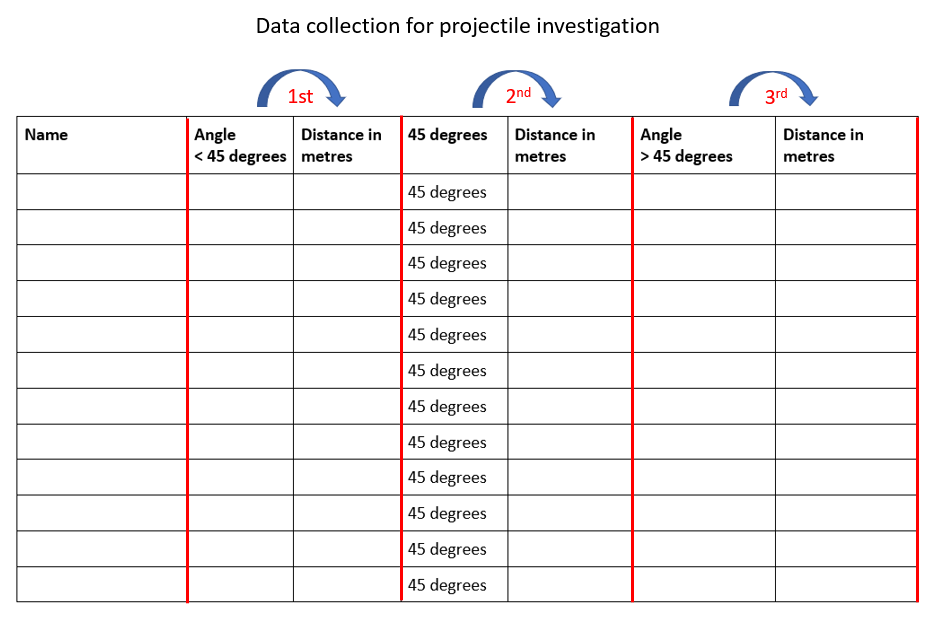
- As this is an outdoor activity, it is recommended that the following table be mounted on a clipboard for the data collection.
- An A4 PDF of this table is available here.
 |
Was this a fair test? Why/why not?Which elements of the air rocket activity fit the criteria for fair tests? Which elements cannot be easily controlled? |
Eratosthenes
The Heliocentric model is that Earth revolves around the Sun. This was a very big idea during the Renaissance (15th and 16th centuries) and in the subsequent Scientific revolution. However, the following video (2:16) featuring Eratosthenes (276 BCE – 194 BCE) shows how the Heliocentric model was discussed much earlier. It is nothing short of remarkable that Eratosthenes was able to measure the circumference of the Earth by applying his geometrical knowledge to astronomy.
Think Make Improve
There are several variations of the design process but the one adopted here is TMI (Think, Make, Improve) first proposed by Martinez and Stager in 2013. “Reducing the process to three steps minimises talking and maximises doing” (Martinez & Stager, 2019, p. 54). TMI is an example of the maxim to “make everything as simple as possible but not simpler” which is widely attributed to Albert Einstein. Children are unlikely to forget the three steps in TMI in contrast to existing design models which “may be too wordy or abstract for young learners” (Martinez & Stager, 2019, p. 54).


Mechanisms and linkages
 |
Create mechanisms to change the direction of movement using split pins as fixed and floating pivots
|
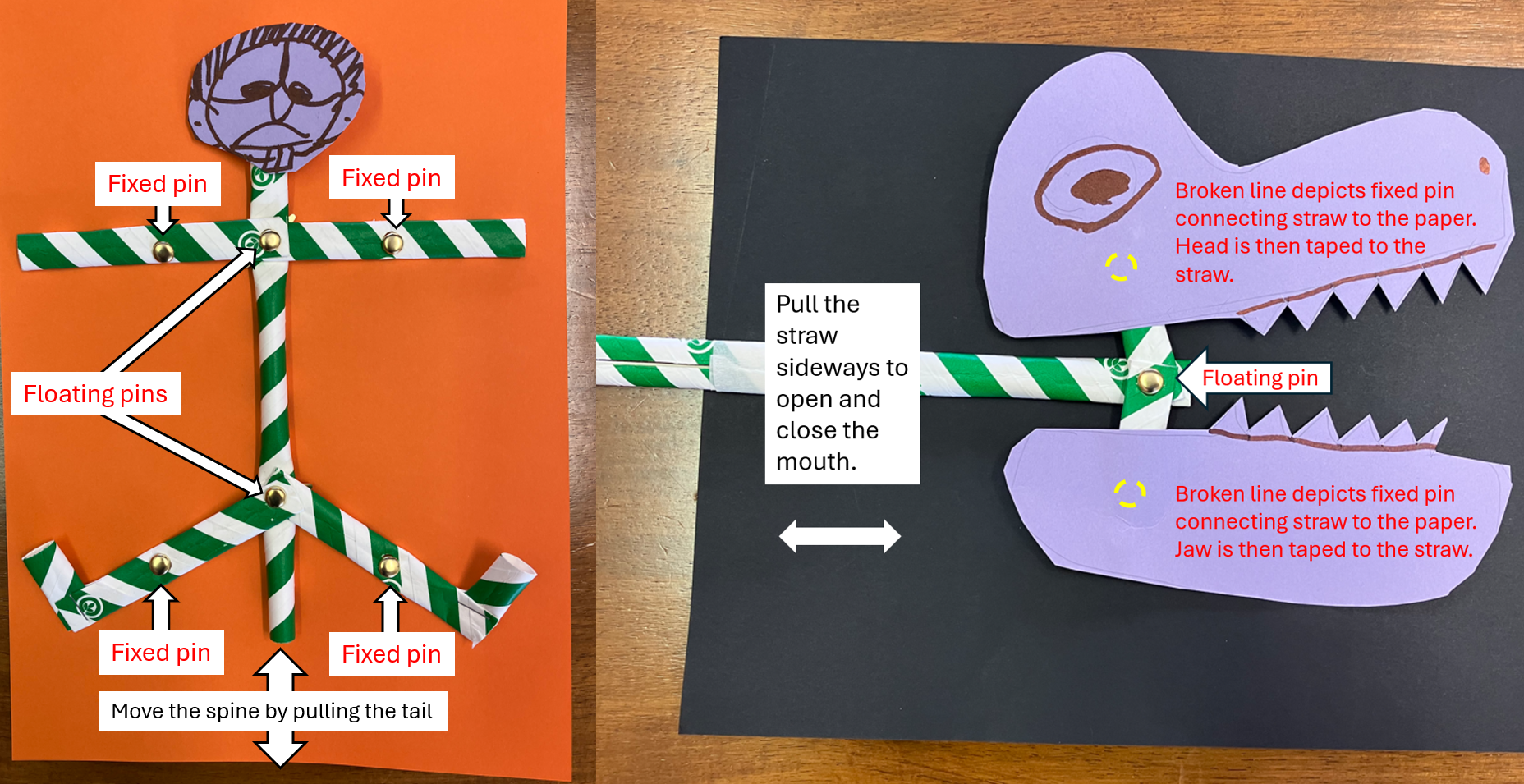
Notes: The stick figure can also be made using a cardboard tube or disposable cup instead of the card stock. This will make the end product more like a toy.
 |
|
Pi (π)
Pi (π) is a number that is the ratio of a circle's circumference (the distance around it) to its diameter (the distance across it). No matter the size of the circle, this ratio is always the same, approximately equal to (3.14). You can think of it as how many diameters it takes to go all the way around a circle—it's always just a little over three times.
|
|
Volume and capacity
Volume is the total amount of space an object occupies while capacity is the maximum amount of fluid a hollow container can hold.
|
Mr Wide and Mr TallUsing a piece of paper, make a cylinder shape in either landscape (i.e., Mr Wide) or portrait (i.e., Mr Tall) orientation.Materials required: Paper, tape, blocks. |
We will test which of the two cylinder designs has the greatest capacity using the following steps:
- Each student makes a tall or wide cylinder using a single piece of paper.
- Students do not need to make a bottom for their cylinders as the table will function as the bottom.
- Tops are not required for the cylinders as easy access is required to fill the cylinders with blocks.
- Although overlapping the paper will give the cylinders more rigidity and strength, do not overlap the paper as this will reduce the capacity.
- Use tape to join the two edges of the paper to complete the cylinder.
Teaching tip: There are many ways to test the two designs but the following steps have proven to be effective:
- Find two students with contrasting designs who are willing to be representatives for the other students.
- Ask all of the students with the Mr Tall design to line up behind the Mr Tall representative (and vice versa) ensuring that all students can see the demonstration table.
- Using small construction blocks, fill the Mr Wide cylinder.
- Rather than count these blocks, simply use the same blocks to fill the Mr Tall cylinder after posing the question, "Let's find out if Mr Tall holds the same, less or more?"
Teaching points:
- During the rope activity for perimeter and area we learned that shape is a determining factor when dealing with perimeter and surface area. The Mr Wide and Mr Tall activity demonstrates that shape affects the volume too.
- Mr Wide had the greatest volume because there was an exponent involved.
- Although Mr Tall had the greatest height, height produces a linear increase.
- Mr Wide had the greatest radius and greatest capacity, as radius produces an exponential increase.
- The following formula shows how to calculate the volume of a cylinder.
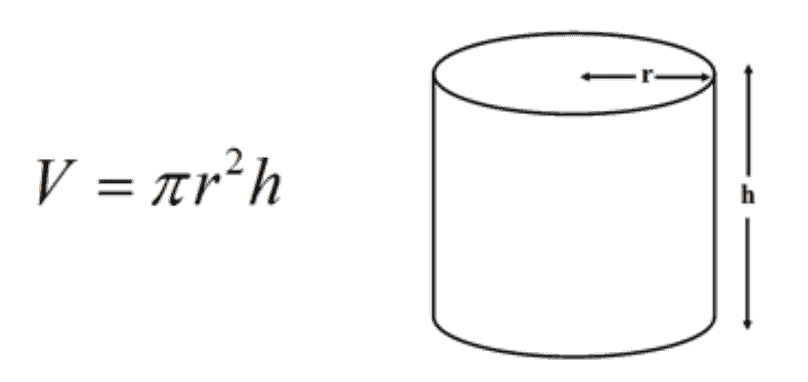
There is a handy online calculator for cylinders at https://www.omnicalculator.com/math/cylinder-volume.
Exploring the ratio of surface area to volume
The main thing to note here is that the ratio of
surface area to capacity is not fixed as shown in the figure
below.
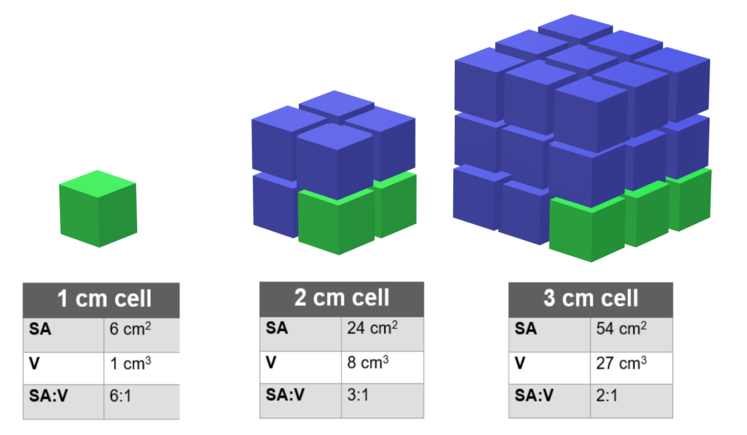

There are many examples of this principle in nature. For example:
- Chewing food into smaller pieces aids digestion as the surface area is increased while the volume remains the same.
- Your fingers are the first parts of your body to get cold as they have a high ratio of surface area to volume.
- Elephants have large ears to help them keep cool as their ears also have a high ratio of surface area to volume.
The ratio of surface area to volume can also be seen when building a campfire. It is common to start with kindling because kindling is small which gives it a larger surface area compared to its volume. This is why kindling burns easily.
Combinations and permutations
In mathematics, when the order doesn't matter it is a combination. When the order does matter it is a permutation. A permutation is an ordered combination.This means that what are commonly called combination locks are really permutation locks.
Exponents
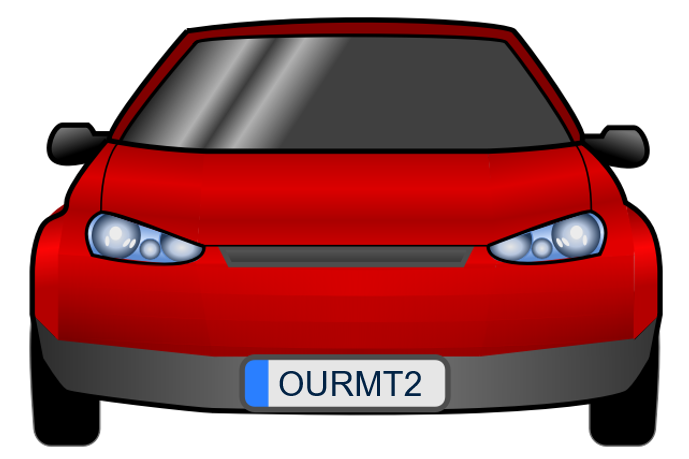
Exponents are not part of the curriculum in primary school. However, the following question and discussion can be used to introduce exponents using car number plates.
 |
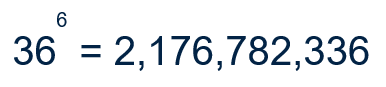
How many permutations are there with a six-character number plate?Note: The actual answer is a very large number (which is at the bottom of this page) so encourage students to answer with a formula which includes an exponent instead. You might need to prompt this discussion by starting with only one character. |
Nanotechnology
The following video (2:26) contains two examples of how nanotechnology is being used in the field of medical research to fight cancer.
Moderated self-assessment
Discussions with students around the key components of conceptual topics and how they fit together can generate insights into student achievement.

------------------
Answer to the exponents question about permutations with six character number plates:
------------------
We welcome your feedback and suggestions
The chief investigator for The SILO Project is Associate Professor Brendan Jacobs, Head of Department STEM Education, University of New England. The SILO Project thrives on incremental improvement so constructive feedback is greatly appreciated. Please contact Brendan via email at bjacobs7@une.edu.au to share your thoughts and recommendations.

This work is licensed under a Creative Commons Attribution-NonCommercial-ShareAlike 4.0 International License